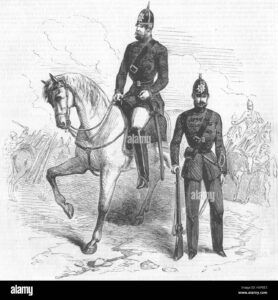
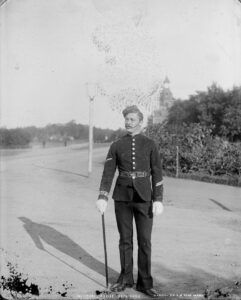
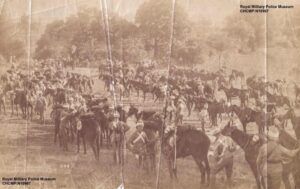
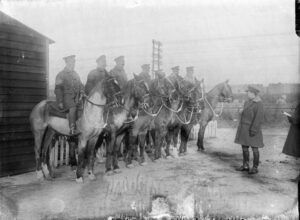
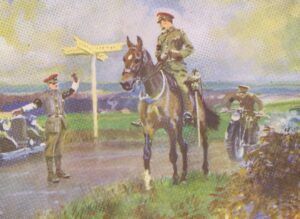
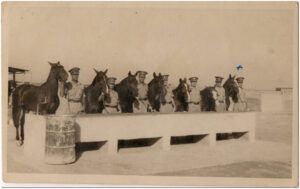
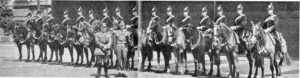
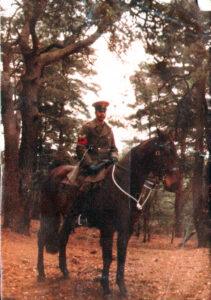
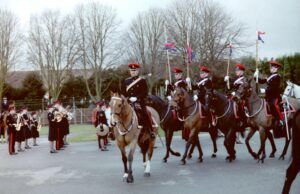
The Mounted Troop’s actual date of establishment is 1855, when the Military Mounted Police was formed to police the new Aldershot cantonment. It became gazetted, as a permanent Corps on 1 August 1877 — the date the corps own “118 years of service” tradition is counted from, while the Imperial War Museums’ War Memorials Register instead counts the Mounted Troop’s “140 year existence” from the 1855 origin. Both figures are correct on their own terms; this page dates the permanent founding itself to 1855.
Table of Contents
Add a header to begin generating the table of contents
1809 – 14
Origins
Wellington’s Staff Corps of Cavalry
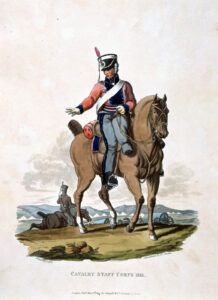
During the Peninsular War, the Duke of Wellington asked for a Provost Marshal to be appointed to control looting among his troops. He raised the Staff Corps of Cavalry — around 144 men in Britain and 142 in Spain and Portugal, under Lieutenant-Colonel George Scovell — to support the Provost service. Its members wore a red scarf on the right shoulder before proper uniforms were issued: an early, though indirect, ancestor of the Redcap. The Corps was disbanded at the end of the war in 1814.
Cavalry Staff Corps 1813
1815–18
Origins
Reformed for the occupation of France
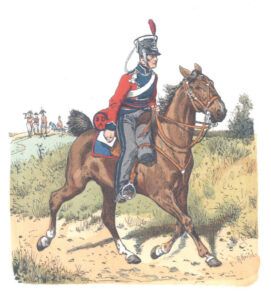
Following Napoleon’s defeat at Waterloo, Wellington re-formed the Staff Corps of Cavalry to police the British Army occupying France. It was disbanded again in 1818 (some sources give 1819) once the occupation ended.
Cavalry Staff Corps 1815
1854–55
Origins
The Mounted Staff Corps in the Crimea
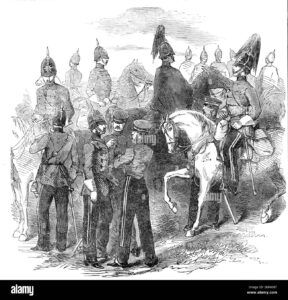
A Mounted Staff Corps of nearly 100 troopers, recruited largely from the constabularies of Ireland and the Metropolitan Police, was raised for the Crimean War to prevent the theft of supplies and maintain camp discipline. It was disbanded when the war ended.
Cavalry Staff Corps 1854
1855
Established
Military Mounted Police formed at Aldershot
A War Office circular of 13 June 1855 directed cavalry regiments to supply men “of sober habits, intelligent, active and capable of exercising a sound discretion” to form a Corps of Mounted Police for the new Aldershot cantonment. On 4 July 1855, twenty-one other ranks — drawn from the 2nd Dragoons, 3rd Light Dragoons, 15th and 7th Hussars and the 17th Lancers — were sent to Aldershot “for the preservation of Good Order in the camp… and for the protection of the inhabitants of the neighbourhood.” This was the first official military use of the word “police.”
Military Mounted Police Crimea 1855
1865–74
Growth
Early expansion
The Corps grew to 32 mounted men by 1865. In 1872 a detachment attended the Army’s annual manoeuvres for the first time under an appointed Assistant Provost Marshal, and in 1874 its first printed standing orders were issued, signed by Major Thomas Trout — the first Provost Marshal to have risen through the Corps’ own ranks.
1877
Gazetted
Gazetted as a permanent Corps
On 1 August 1877 the Military Mounted Police (MMP) was gazetted as a distinct, permanent corps for service at home and abroad, with an increased establishment of 75 — one sergeant-major, seven sergeants, thirteen corporals, fifty-four privates — and 71 horses. From this point the Corps kept its own muster and pay rolls, with promotion handled internally. This gazetting is the date from which the Corps’ own “118 years of service” tradition is counted; the Mounted Troop’s actual establishment dates from 1855.
1882–84
Campaign service
First action: Egypt
The Military Mounted Police saw its first overseas deployment and first combat during the Egyptian campaign, including at the Battle of Tel-el-Kebir (1882) and Suakin/El Teb, and with the Nile Expeditionary Force. Medals were earned and casualties suffered.
1885
Sister corps
Military Foot Police established
A sister corps, the Military Foot Police (MFP), was raised in 1882 for special service in Egypt, recruited from men recalled to the Colours who had served in the Metropolitan Police, and confirmed as a permanent corps on 2 July 1885. Though technically independent of the Mounted Police, the two functioned in practice as a single organisation.
Military Foot Police 1895
1899–1902
Campaign service
Second Anglo-Boer War
By the turn of the century the Military Police numbered just over 300, with permanent detachments in Cairo and Malta as well as UK garrison towns. The majority of both Mounted and Foot Police eventually served in South Africa during the Second Boer War.
Military Mounted Police Boer War c1899-1902
1914–18
First World War
Rapid wartime growth
Military Police strength stood at 508 all ranks in 1914 and reached over 25,000 by 1918. Mounted and Foot Police policed stragglers, controlled traffic, guarded prisoners of war, and even policed the Royal Flying Corps until the Royal Air Force Police was formed in 1918. The Battle of Neuve Chapelle (1915) and the confusion at the Battle of Loos both demonstrated the growing importance of coordinated traffic control. The Corps suffered 375 casualties in the war, and its members received 65 Distinguished Conduct Medals and 260 Military Medals.
Military Mounted Police c1916
1926
Amalgamation
Corps of Military Police formed
On 27 February 1926 the Military Mounted Police and Military Foot Police were fully amalgamated into a single Corps of Military Police (CMP), re-established at a peacetime strength of 508 — the same figure as before the First World War.
Combined MMP and MFP 1926
1939–45
Second World War
From 4,121 to over 50,000
Mobilised in August 1939 at a strength of only 584, the CMP grew to over 50,000 across six specialist branches, including the Special Investigation Branch and Parachute Provost. Military Police served with the BEF in France, at Dunkirk, El Alamein, Malta and Monte Cassino, parachuted into both Arnhem, and Normandy prior to ‘D’ Day. They also landed on the beaches of Normandy. The Corps recorded 912 names on its Second World War Roll of Honour and won 229 operational awards, including 7 Military Crosses and 6 Distinguished Conduct Medals.
CMP-Mounted-WWII
1946
Royal honour
The ‘Royal’ prefix granted
On 28 November 1946, in recognition of its record across both World Wars, King George VI granted the Corps the title Corps of Royal Military Police (RMP) by Army Order 167 — choosing “RMP” over “CRMP” in part to avoid confusion with the Royal Canadian Mounted Police.
1950
Mounted Troop
Horse detachment revived at Aldershot
A horsed detachment of the RMP, which had lapsed after the Second World War, was recreated in 1950 and based at Aldershot. Its stated purpose was twofold: practical Policing & patrol duties in terrain unsuited to vehicles, and preservation of the mounted policing tradition dating back to the nineteenth century which included the policing of the Aldershot garrison and town, as well as surrounding towns and villages.
The Troop would also deploy to patrol other Military Establishments and training areas around the UK, by detaching usually two NCO’s for the purpose.
The Troop worked closely with the Hampshi
The unit also took on a ceremonial role, including:
Ceremonial Escorts for the Royal Family and other state occasions.
Crowd Control at Hyde Park London during gun salutes performed by the Royal Horse Artillery.
Taking part in ceremonial parades around the UK, including the Edinburgh Military Tattoo etc .
RMP-Mounted-Aldershot-c1955
1977
Royal patronage
Queen Elizabeth II becomes Colonel-in-Chief
Elizabeth II became Colonel-in-Chief of the Corps in 1977, formalising royal patronage that the ceremonial Mounted Troop, among other RMP elements, represented on her Silver Jubilee parade. A detachment of 6 mounted NCOs and 1 officer escorted HM The Queen that year at her own request, on the occasion of her becoming Colonel-in-Chief.
1978
New Detachment
Longmoor
A new permanent Mounted troop detachment was created at Longmoor Training Camp in Hampshire consisting of 1 permanent NCO, and 1 intermittent NCO. The horses were stabled on site and a former married quarter was converted into both duty and living space.
Until this point it was usually policed by a two NCO Detachment from the stables at Aldershot, but only on a single daily basis.
The purpose of the Detachment was to police both the Longmoor training area and surrounding ranges. Also to police the military areas in Bordon which also include married quarters and the RAF Station.
RMP-Mounted-Longmoor-1978
1981
Royal occasion
Wedding of Lady Diana Spencer
A detachment of 4 mounted NCOs escorted Lady Diana Spencer to St Paul’s Cathedral ahead of her wedding to Prince Charles on 29 July 1981.
1992
Reorganisation
RMP joins the Adjutant General’s Corps
On 6 April 1992 the RMP lost its status as an independent corps, amalgamating with the Military Provost Staff Corps to form the Provost Branch of the newly created Adjutant General’s Corps (AGC). The RMP was permitted to keep its name, cap badge and red cap.
1995
Disbandment
The Mounted Troop stands down
By the early 1970’s the Mounted Troop had been reduced to around 20 personnel. On 5 March 1995 it was formally disbanded, bringing to an end 140 years of mounted service reckoned from its 1855 establishment (118 years by the Corps’ own tradition, counted from its 1877 gazetting) — and a lineage of mounted military policing stretching back, with interruptions, to Wellington’s Peninsular War cavalry. A memorial stained-glass window, and a Bronze statue commemorate all who served and died across the Mounted Troop’s history.