Formative Dates
1855
Formation of Military Mounted Police
1877
Corps of Military Mounted Police Gazetted
1950
Re-Formation of Corps of Royal Military Police Mounted Troop UK
1995
Disbandment of Corps of Royal Military Police Mounted Troop
IMAGES
Menu
Beaumont Barracks & the Infirmary Stables
The buildings the Mounted Troop is most closely associated with began life as something else entirely: a horse hospital.
In 1858, the Army began building a central infirmary stable on the high ground of Mount Pleasant, on Aldershot’s southern ridge — a site chosen because its sandy soil, though too poor for heavy construction, drained well enough for stabling.
The result was three ranges of infirmary stables, one to serve each of Aldershot’s East, West and South Cavalry Barracks, each range holding 24 individual stables (16 stalls and 8 loose boxes), fronted by verandas so horses could be moved under cover, and designed so any stable could be converted into an operating theatre or treatment room at need.
From horse hospital to veterinary hospital
The 1858 infirmary was built only for general upkeep, not serious treatment. That changed after the Second Anglo-Boer War (1899–1902), in which the Army lost roughly two-thirds of its horses — mostly to infection and disease rather than combat.
In response, the site was expanded from 1901 into a proper Veterinary Hospital, with an operating theatre, pharmacy, farriers’ and dressing sheds, further stabling for over 60 animals, and a dedicated isolation ward to stop the mixing of sick and healthy horses that had proved so costly in South Africa. The new buildings were finished in 1910.
The Hospital became part of a “Royal visiting circuit,” used to show off British Army veterinary standards to state visitors — among them King Feisal of Iraq and the Emir of Katsina, Muhammadu Dikko, both in 1933.
Naming and mechanisation
The South Cavalry Barracks that the Infirmary Stables served were not formally named Beaumont Barracks until 1909 (the East and West Cavalry Barracks becoming Warburg and Willems Barracks at the same time). Through the 1930s, mechanisation steadily replaced the horse across the Army; the site was still used during the Second World War, but need fell sharply as 4×4 vehicles took over roles horses had always filled.
—– The Mounted Troop moves in
From Household Cavalry loan to RMP stable block
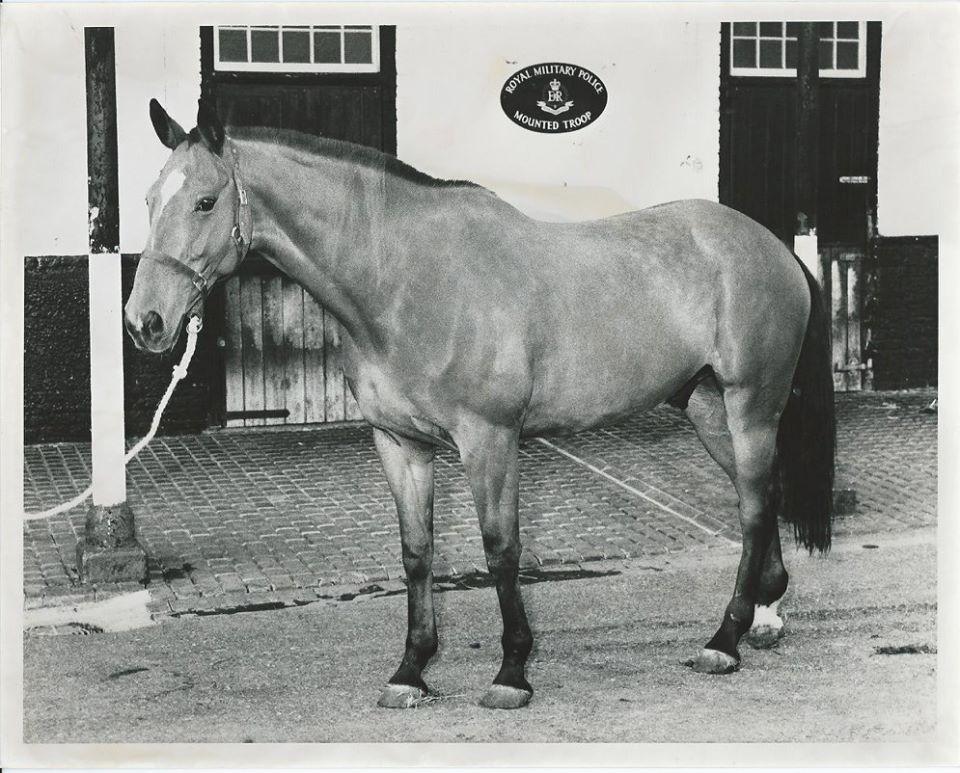
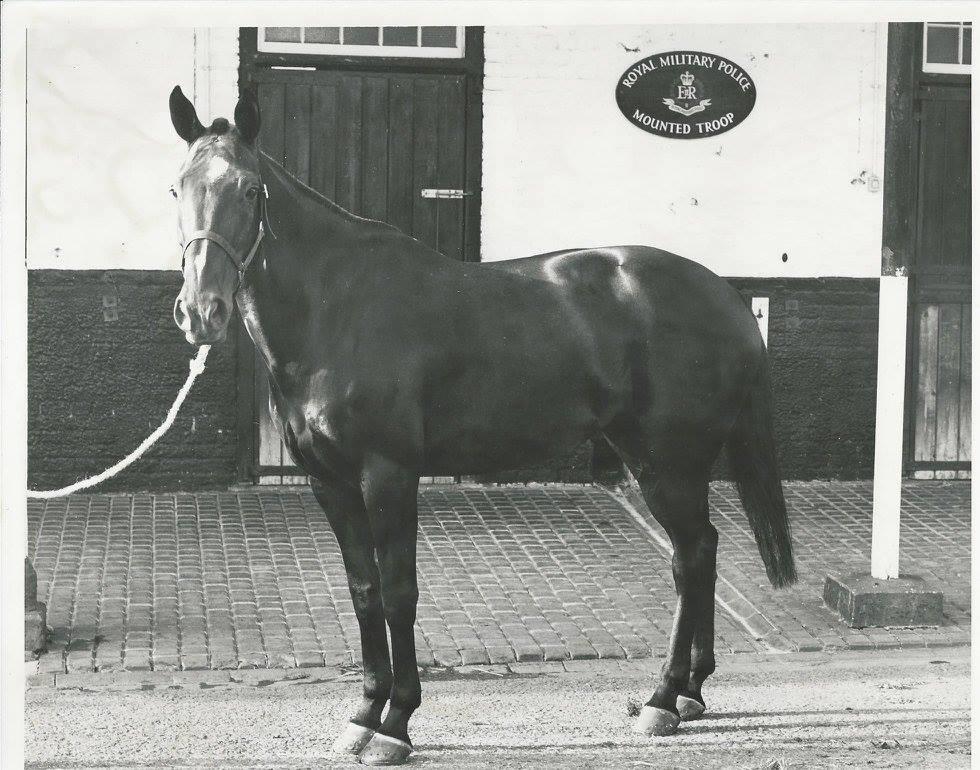
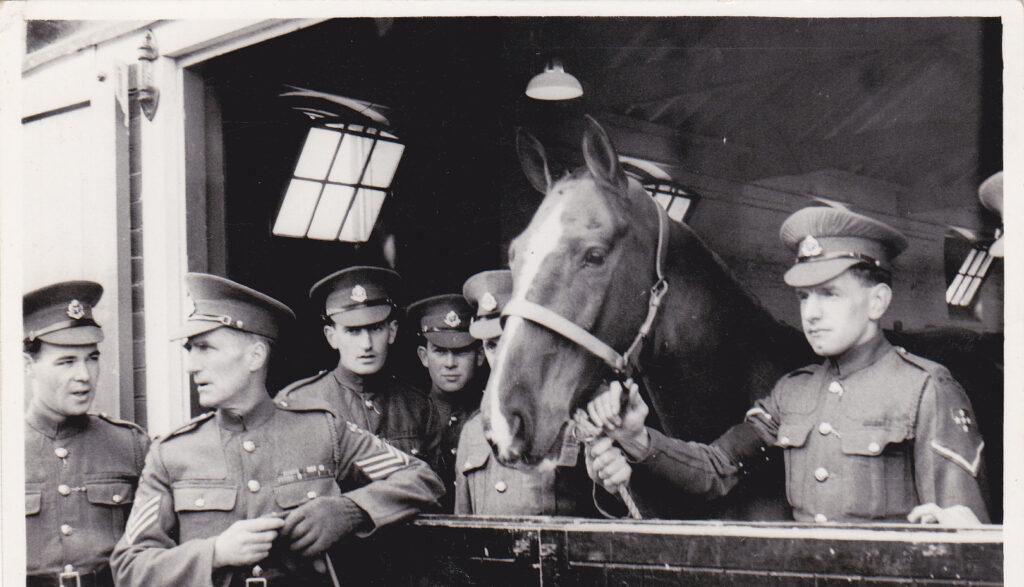
Post-war decline set in quickly. The old Veterinary Hospital survived mainly as a temporary facility for visiting mounted units rather than as anyone’s permanent barracks. The Household Cavalry used the stables in the late 1950s and early 1960s, and the last unit to be based there formally was the Royal Corps of Transport’s pack mules, which disbanded in 1965. After that, the stable blocks passed to the Royal Military Police — home, from this point, to the Mounted Troop that had been revived at Aldershot in 1950.
As well as the stabling, the Troop also had a dedicated Farriers Forge at the bottom of the yard with a permanent RAVC (Royal Army Veterinary Corps), Farrier attached to the Troop. Also in that same part of the yard was stabling for the local ‘Riding for the Disabled’ group. Who were able to use the riding school facilities.
The RMP kept the Beaumont stables until the Mounted Troop’s disbandment on 5 March 1995, when the remaining blocks were handed to the Garrison Stable Club.
—— Demolition and legacy
What became of Beaumont Barracks
The wider Beaumont Barracks — the cavalry barrack blocks themselves, as opposed to the separate Infirmary Stables — did not survive the twentieth century. As Aldershot’s Victorian garrison was redeveloped in the 1960s, Beaumont was the last of the original Permanent Barracks left standing, briefly even housing the Garrison Headquarters between 1968 and 1971. Conservation efforts, including submissions by the Victorian Society, failed to save it: by the end of 1976 Beaumont Barracks was demolished in full, except for its Riding School (given Listed Building status in 1973) and its gates and guardrooms. The civilian Beaumont Park development opened on the site on 3 October 1979.
The separate Infirmary Stables / Veterinary Hospital site, where the RMP Mounted Troop was actually based, outlived the barracks itself by two further decades under RMP and then Garrison Stable Club use, finally closing in 2000. The land was sold and redeveloped as Beaumont Village, a retirement community that stands there today and still displays a plaque noting the site’s military history.
Other stabling of mounted military police at Aldershot
The original 1855 detachment
The first 21 mounted policemen sent to Aldershot in July 1855 were seconded from cavalry regiments already in garrison there — the 2nd Dragoons, 3rd Light Dragoons, 16th Lancers, 7th Hussars and 15th Hussars — and were carried as supernumeraries on those regiments’ own muster rolls.
In this earliest period the Corps had no stabling of its own: its men and horses would have used the existing cavalry lines and temporary hutted stabling of the 1850s camp, alongside the regiments that supplied them.
The Permanent Cavalry Barracks, 1859 onward
When Aldershot’s brick-built Permanent Barracks were completed in 1859, three cavalry barracks were built to the same design, each with four troop stables (horses on the ground floor, men’s rooms above), an Officers’ Mess, a Sergeants’ Mess and a Riding School. These were the East, West and South Cavalry Barracks, renamed Warburg, Willems and Beaumont in 1909. As the Corps of Military Mounted Police grew through the later nineteenth century it would have drawn on this general Aldershot cavalry stabling infrastructure, alongside the cavalry regiments themselves, well before the dedicated Infirmary Stables at Beaumont became its long-term home in the mid-1960s.
Historical Note:
Winston Churchill joined the cavalry in February 1895 after passing out of Sandhurst, and he was initially placed in the 4th Hussars. He completed his training at Beaumont Barracks before seeing action in various military campaigns.
Further to this, in 1872 a movie called ‘Young Winston’ was released,which was about the early years of Winston Churchill’s life. The scenes of him being trained as a cavalry officer, were filmed in the RMP Mounted troop Riding School, at Beaumont Barracks, with the Mounted Troop being used as the extras in the movie, and TSM Bill Griffiths, (Troop Sergeant Major) at the time playing the part of his instructor.
To see the relevant clip, CLICK HERE …..